
At some point in our lives, most of us will deal with dementia – our own or that of a loved one. Until researchers unravel the mystery of the brain and find a cure, that’s the reality of aging.
My father had Alzheimer’s. It was a long, drawn-out decline spanning many years. It was hard to watch the person who was such a role model and inspiration – a dad who seemed larger than life – gradually lose cognitive abilities, slowly forgetting his accomplishments and the family he raised. It was hard for all of us to understand what was happening, let alone know how to interact with a loved one who is slipping away.
That is why I will always be grateful for a friend who came into my life at a time I need answers to questions I didn’t know I had.
I first met Kathy Rhoads in a group fitness classes at the gym where I used to teach. Over the years, we got to be good friends, sharing coffee and conversation with other participants after class. We learned that we had children of similar ages and we talked about our careers.
I was intrigued when she told me she was a geriatric social worker and owned an adult day center. I didn’t even know such a thing existed, but I am so glad that it does. While my father didn’t attend her program, she was able to answer a lot of questions about how to interact with a family member with dementia, what they are capable of and what to expect over time.
She explained why many people are hesitant to disclose a diagnosis or to talk about the struggles they and their family members are facing. “They are afraid of losing the life they’ve had with that person. When their spouse or loved one can no longer participate in shared activities such as bridge or spending time with other couples or when they start acting differently, they don’t know what to do so they isolate themselves.”
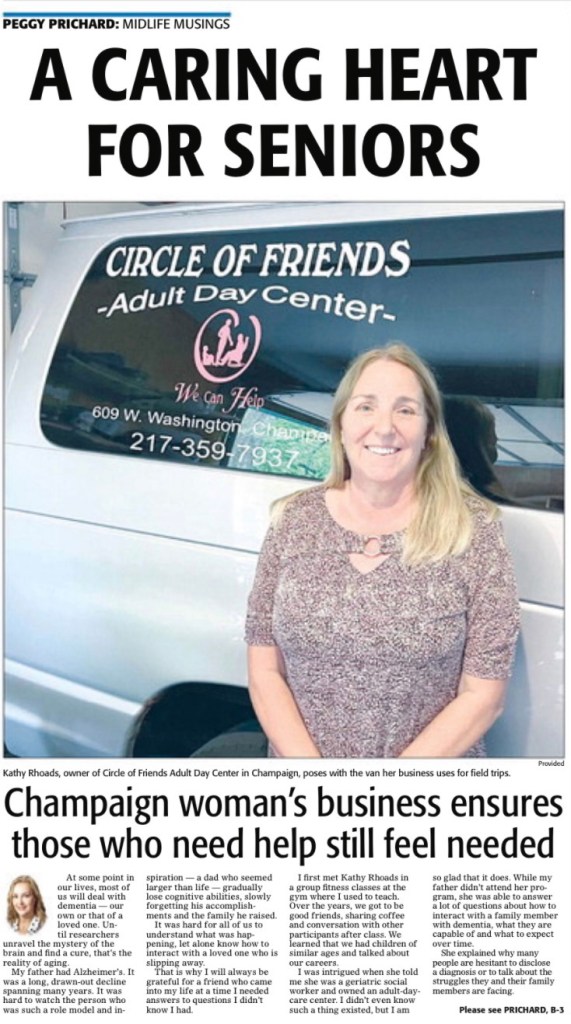
Kathy received her MSW in social work at Arizona State University. She realized she loved working with seniors while taking courses in gerontology. When her husband got at job teaching at the U of I, they moved to Champaign. She opened “Circle of Friends Adult Day Center” in 1997.
The business is located on a quiet street an older neighborhood in Champaign. From the outside it looks like a typical ranch home. The house has several rooms of assorted sizes for various activities, a kitchen, a fenced yard for outdoor recreation and a basement with a pool table, meeting rooms and offices.
Her “customers,” (she prefers not to call them patients or clients), include people who may have physical limitations, are lonely or feel isolated. Others may have various types and stages of dementia, but there doesn’t need to be an “official” diagnosis, nor is there an age requirement.
“We provide respite for caregivers whose loved ones may be struggling with memory issues, says Kathy, but we aren’t a babysitting service. People participate in activities here. They still have gifts to share. They become part of a group. Often, we get to know them when they are “on their way down,” yet we can see the things that they can still do that their family members may not.”
She mentioned that some of her customers come to Circle of Friends to interact and help others who participate in the services which include all kinds of social and creative activities, exercises, games and more. She even had a participant who was able to drive herself to the facility. “She enjoyed helping out and liked feeling needed.”
When asked what the best thing about her job is, Kathy smiled and said “it’s when people say they want to keep coming back.” Often, when a family member or caregiver brings their loved one to try out Circle of Friends, they are resistant. They don’t want to be “babysat.”
We make sure to learn their gifts and integrate them into the rest of the group. Maybe they can play piano or have expertise in other areas. Having dementia doesn’t mean you can’t still learn,” she stresses. “When they feel purpose, they become much more positive.”
Others have found that attending Circle of Friends may delay the need to place a family member in a care facility. “Often, just having a place for them to go and the activities and services provided will make it possible to keep them at home longer,” says Rhoads.
Kathy shared the story of a woman arriving at the door of her business looking desperate and disheveled. “She said she needed someplace for her husband to stay for a week while they waited for an opening at a nursing home.”
“He did so well here that she ended up bringing him back for eight months before he eventually required more round the clock care. When she stopped in to talk a few weeks after he started attending, I almost didn’t recognize her. She was dressed up, with hair and make-up. She looked like a different person. She just needed those hours in the day to take care of herself.”
When asked what activies and services are available, I was handed a daily schedule that included; music appreciation, current event discussions, seated exercise, spiritual grown experience, themed activities, active and board games and much more. They also serve breakfast, lunch and snacks and have a van used for field trips.
Rhoad’s staff includes a social worker (herself), a registered nurse, an activities director and several CNA’s (certified nursing assistants.) She leads twice monthly support groups for caregivers and family members.
“Family members aren’t trained to work with people with dementia. Often, they want to pull them into “our” reality, thinking; “if we just explain things enough times, they will finally understand,” but it doesn’t work that way, Rhoad’s stresses. We need to meet them in their reality.”
“Running an adult day center isn’t always easy,” Kathy stated. “I have a great staff but a small staff. It’s hard to cover if someone needs time off.” She works with the University of Illinois to provide internships for students enrolled in the School of Social Work, Interdisciplinary Health, and Education, to name a few.
“My goal in life is to train as many people as possible in geriatric care. There is a health crisis in this country and we need the younger generation interested and trained in this field. Also, families don’t know what’s out there to help them if their loved one has dementia. They shouldn’t have to go through this journey alone.”
Rhoads says that keeping her business afloat during Covid was particularly challenging. “We were closed for nearly two years. During that time, I’d ride my bike to customers homes and deliver activity packets. We also tried to do Zoom activies, but seniors and technology don’t typically mix.” The resulting social isolation was also very hard for her customers, she added, “people just aren’t meant to be alone.”
Kathy credits funding from the Department on Aging and a PPP loan for keeping her business from going under during that time. She said she’s getting back to normal participation numbers and had 20 participants on the day I visited her facility. She’d like to have closer to 30.
During our conversation, Kathy shared an anecdote about her son who, while growing up, occasionally spent time with her at work. He’s now employed as a nurse and credits his ability to interact with dementia patients to the skills he learned watching his mother do her job. “He just knows what to say and do to make them feel understood,” she said proudly.
Rhoads says that many people aren’t aware of the services and assistance available for seniors needing this type of help. She often helps families navigate the many options they have, and points out that our area has quite a bit to offer.
Some of these services include:
- CRIS Healthy Ageing: a resource for seniors and their caregivers providing education, health, financial, social and supportive services. 217-355-1543
- Family Service of Champaign County senior resource center: provides homecare, meals on wheels, counseling and transportation. 227-352-5100
- Champaign County Regional planning commission – senior services providing case management and referral services. 217-328-3313
Our community is fortunate to have people like Kathy. Her caring heart and dedication to helping the elderly has resulted in a much needed service – providing respite for caregivers and a safe place for their loved ones to spend their days – purposefully and with dignity. I can’t think of a more fitting name for her business. Circle of Friends is all that and more.
For more information about Circle of Friends, call (217) 359-7937, email: center@circleoffriendsadc.net or visit the website at http://www.circleoffriendsadc.net
 Midlife Musings
Love this – “Our community is fortunate to have people like Kathy. Her caring heart and dedication to helping the elderly has resulted in a much-needed service – providing respite for caregivers and a safe place for their loved ones to spend their days – purposefully and with dignity.”
LikeLike