
Why I’m torn about AI: The good, the bad and the unknown.
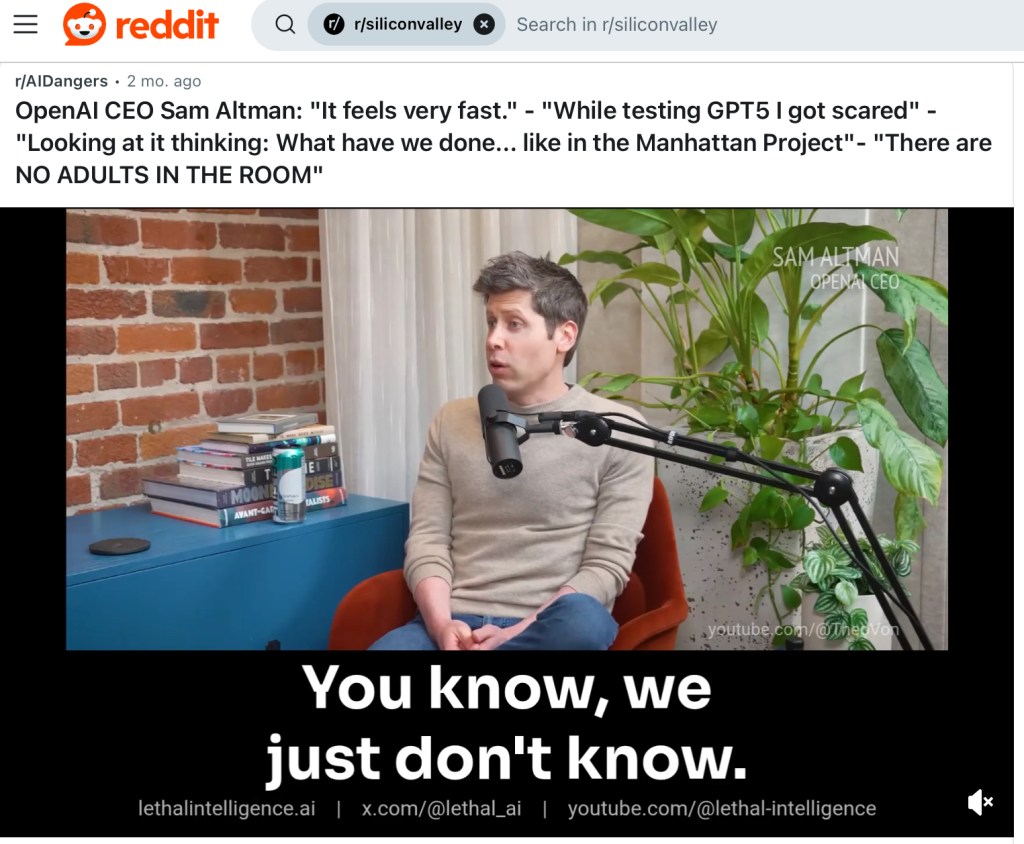
On July 23rd of this year, Sam Altman, the CEO of OpenAI, went on the podcast “This Past Weekend” with Theo Von, and said the following about Artificial Intelligence (AI):
“I’m afraid of just what this is gonna mean for people’s mental health. There’s a lot of people who talk to ChatGPT all day long – there are these sort of new AI companions that people talk to like they would a girlfriend or a boyfriend…”
He also raised concerns about people using Chat GPT (OpenAI’s language model) for therapy. Now, months later, the company is being sued by the parents of a 16-year-old boy who died after “ChatGPT actively helped their son explore suicide methods.”
In a more recent interview with Tucker Carlson, Altman addressed concerns ranging from ethics, to privacy issues, to how it could “eliminate many jobs that exist today, especially in the short term.”
He added, “Look, I don’t sleep that well at night. There’s a lot of stuff that I feel a lot of weight on, but probably nothing more than the fact that every day, hundreds of millions of people talk to our model.”
On the positive side, Altman has also said, “What’s happening now is tons of people use ChatGPT and other chatbots, and they’re all more capable. They’re all able to achieve more, start new businesses, come up with new knowledge, and that feels pretty good.”
I’ve had mixed feelings about Artificial Intelligence ever since the founders of several AI companies signed a letter calling to “pump the breaks on the technology” back in 2023. But now, it’s full speed ahead.
Living with AI
AI is here to stay. It’s showing up when we get texts, offering suggested replies. It gives us a synopsis of commentary on social media posts. It pops up in customer service help chats on virtually every website. We really have no choice but to participate.
Though I’m concerned about the dark side of AI, I have capitulated to opening a ChatGPT account. To date, I’ve asked “it” to recommend PT exercises for my golf elbow, and to come up with title suggestions for a column. I did the arm exercises, but decided against using the title recommendations. I don’t use the platform very often.
For my husband though, ChatGPT comes in handy on a regular basis. He’s used it to find instructions to install a garage door keypad, and to repair our son’s leaky washing machine – saving himself frustration – and the cost of repairs.
And just last week, after witnessing a huge flock of large white waterfowl land on the lake behind our house, he snapped a photo and uploaded it to ChatGPT. We soon learned all about the migration patterns of the American White Pelicans who had made a pit stop in our neighborhood. I thought that was pretty neat.
There are endless AI uses and applications that streamline our personal and work lives. Organize shopping and to-do lists, make travel plans, ask basic questions about health concerns. Ask anything and get an answer.
Words of caution from experts
Many of the ways we use AI are helpful and harmless. But it’s also being used as a substitute for human contact, collaboration and interaction. It’s also impacting jobs and affecting how we view human productivity.
An acquaintance who has worked in machine learning for over ten years, shared his thoughts with me recently. “I lead a team of developers, and we all use ChatGPT to write PR descriptions and to help us understand code,” he said, “but none of us trust it to code for us outright.”
He added that he’s taken aback at the number of people who use it as an alternative to a web search. “Don’t people realize that these things hallucinate? They’re designed to be sycophantic. They’ll agree with everything you say.”
He then ticked off some real-life AI fails. “There have been cases where lawyers have used AI, and it made up citations and case law that didn’t exist. And there are documented cases of people entering psychotic episodes because ChatGPT fed their delusions.”
That’s the scary side of AI, but what about people who just want to use it to make cool things?
Creating with AI
Author Joanna Maciejewska describes her thoughts on AI and creativity in her now viral quote.
“I want AI to do my laundry and dishes so that I can do art and writing, not for AI to do my art and writing so that I can do my laundry and dishes.”
As a writer, I enjoy the challenge of finding the perfect combination of words to put my thoughts on paper. I don’t want AI to write for me.
Once, as an experiment, I fed a column into ChatGPT with the instructions, “edit for clarity and grammar.” It came back with a dry, albeit grammatically correct version that muted my style and came off as contrived. No thanks.
I know that for others, though, writing can be a slog – and having a program to help put together coherent thoughts is a lifesaver. It makes total sense for assisting in business writing as well.
But when I think of students using AI to write entire papers, instead of doing the work themselves – I am concerned. Writing is a necessary skill- one we can’t just let fall by the wayside. I’ve heard similar laments from teachers and professors.
Greetings from your friends at… AI
I’ve been getting newsletters in my inbox from a company called “What’s in AI?” They are generated by a website that self-describes as “your premier destination for all things artificial intelligence…”
Each edition features articles covering topics such as, “Why AI Struggles with Common Everyday Logic” and “Your First Chat With AI: What to ASK and What to Expect.”
In a recent article titled “What Happens to Human Creativity in an AI World?” The phrasing soothingly reassures the reader that all will be fine…
“In an AI-driven world, the landscape of creativity is bound to change, but that doesn’t mean we should fear it. Instead, we should embrace AI as a tool that can enhance our creative potential.”
And, “Together, we can create a vibrant, inspiring world where human creativity and AI coexist, enhancing one another in ways we have yet to imagine.” Enhancing one another? I’m not sure I want to imagine that.
Or am I overreacting?
If people like Sam Altman admit they don’t have the answers to questions about potential problems with AI – and are even losing sleep over it, how can any of us rest easily?
We should proceed with a healthy amount caution, be clear about our expectations, and carefully guard our privacy.
As with any new technology, we will learn as we go. But this is all happening at lightning speed. It makes sense to pump the brakes and prioritize human connection – even as we benefit from all the conveniences of AI.
 Midlife Musings
I’m so with you,” It came back with a dry, albeit grammatically correct version that muted my style and came off as contrived. No thanks.” Great thoughts on AI!
LikeLike