

In search of a good night’s sleep
“The worst thing in the world is to try to sleep and not to.” – F. Scott Fitzgerald
Many of us struggle to get a good night’s sleep. We toss and turn, we may get to sleep, then wake up at two or three am. We struggle to get comfortable. We can’t turn off our internal thoughts. We worry and dissect things we said or did. Then we worry about not being able to sleep. It’s a vicious cycle.
Sleep is one of the most important pillars of health, it’s needed for our brain to recharge, repair, and reorganize. Without adequate sleep, our brain’s ability to function is negatively impacted, affecting everything memory, focus, mood and decision-making skills.
For many of us, getting a good night’s sleep is frustratingly elusive, yet those among the sleep deprived can take some comfort in knowing they’re not alone.
According to the National Institute of Health (NIH) an estimated 30-35% of adults in the United States experience insomnia at some point in their lives, and 10-15% suffer from chronic insomnia, defined as difficulty falling or staying asleep for at least three nights a week for three months or more.
The reasons behind this are many and vary over our life’s journey. Sleepless nights with a newborn, or young children. Worry over teenagers who stay out late. Stress over finances, school, jobs, and relationships. And as we age, hormone disruptors, joint pain and any number of health related causes. Even pets can disrupt our sleep.
Insomnia can drain energy levels and affect our mood, health, work performance and quality of life. What’s worse, chronic sleep deprivation can lead to serious cognitive and emotional challenges and an increased risk of long-term brain diseases like Alzheimer’s.
So what constitutes a good night’s sleep?
The amount of sleep an individual needs varies from person to person – but experts say that most adults need 7 to 9 hours a night.
How many of us can say we get that amount on a consistent basis? With the popularity of sleep trackers on watches and apps, it’s easy to monitor our sleep patterns and rhythms at home. My husband uses a feature on his Garmin watch to track the quality of his sleep. He often shares the data with me, but I don’t need technology to know that my sleep is frequently subpar.
What’s an insomniac to do?
My 79-year-old neighbor has struggled with insomnia her entire adult life. She rarely sleeps more than four hours and will often wake up at 2am, read for an hour, fall back to sleep, wake up again at 4am and start her day. She’ll read, exercise, cook, clean, etc. She’s “tried everything” from sleep studies to prescription pills to no avail, and is now convinced that she just doesn’t need that much sleep.
I can relate. I try to follow good sleep hygiene tips as recommended by sleep experts, which include: getting moderate to high-intensity physical activity during the day; avoiding naps longer than 30 minutes; getting exposure to bright natural light in the mornings; keeping the bedroom cool and dark; limiting caffeine; limiting screen time at least an hour before bedtime; and establishing a regular sleep schedule.
Yet, I still struggle to get a solid eight hours. Part of it has to do with a hip injury that makes it almost impossible to find a comfortable sleeping position, and part has to do with an overactive mind that seems to snap to alertness the minute I climb into bed.
I’ve found that listening to sleep stories or an audio book helps quiet my thoughts. I may get 4-5 hours of semi-restful sleep, but still wake before 5am – earlier than I’d like to start my day. So, I’ll listen to a few more chapters of an audio book, or a podcast – and either doze off or at least postpone getting out of bed for a bit longer.
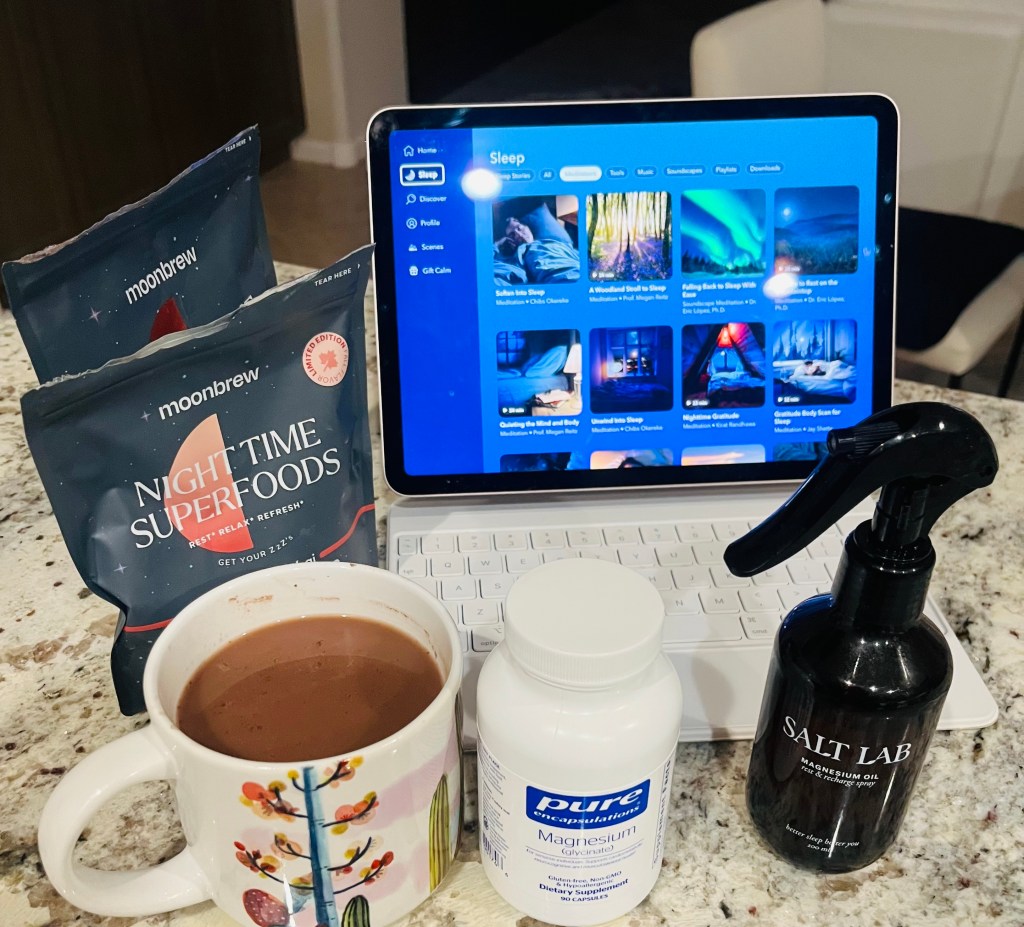
I’d love to wake up more rested and refreshed, but since I’m not one for prescription sleep aids, I’m on the lookout for more natural solutions. Enter the sleep supplement of the moment, Magnesium. In fact, the internet and social media is chock full of ads for magnesium infused sleep remedies.
From a scientific perspective, it makes perfect sense. Magnesium is an essential mineral that plays a role in many bodily functions – including sleep.
It helps regulate the neurotransmitters involved in calming and relaxing the nervous system. It supports the production of melatonin and may even reduce cortisol (a stress hormone) levels. Magnesium also contributes to muscle relaxation.
So could this be the miracle sleep aid we’ve all been waiting for?
Based on feedback from my “non-scientific” sleep survey, it sure seems like it. I asked followers on Facebook, “What are your tips for getting enough Zs?” A few credited regular exercise, limiting alcohol, hormone replacement therapy and even chasing grandchildren as keys to better sleep – but use of products containing Magnesium emerged as the most popular answer by far.
Recommendations included Magnesium lotions, Magnesium oil sprays (spritz on the soles of the feet before bed for maximum results) and Magnesium citrate in both capsule and liquid forms.
I admit that I also jumped on the bandwagon, and tempted by an Instagram ad, purchased a product called “Moonbrew” – a powdered drink mix containing magnesium and several other herbal ingredients. It comes in a variety of flavors and promises sweet dreams for those who imbibe.
I have been drinking a mug of the hot cocoa flavor before bed for a few months now and it does seem to increase relaxation and helps me to fall asleep faster. The jury is still out on the magnesium foot spray though – an impulse purchase I blame entirely on the algorithm.
Perhaps, in the quest to get a good night’s sleep, we are willing to try just about anything.
After all, in the words of Thomas Dekker, “Sleep is the golden chain that ties health and our bodies together.”
 Midlife Musings