
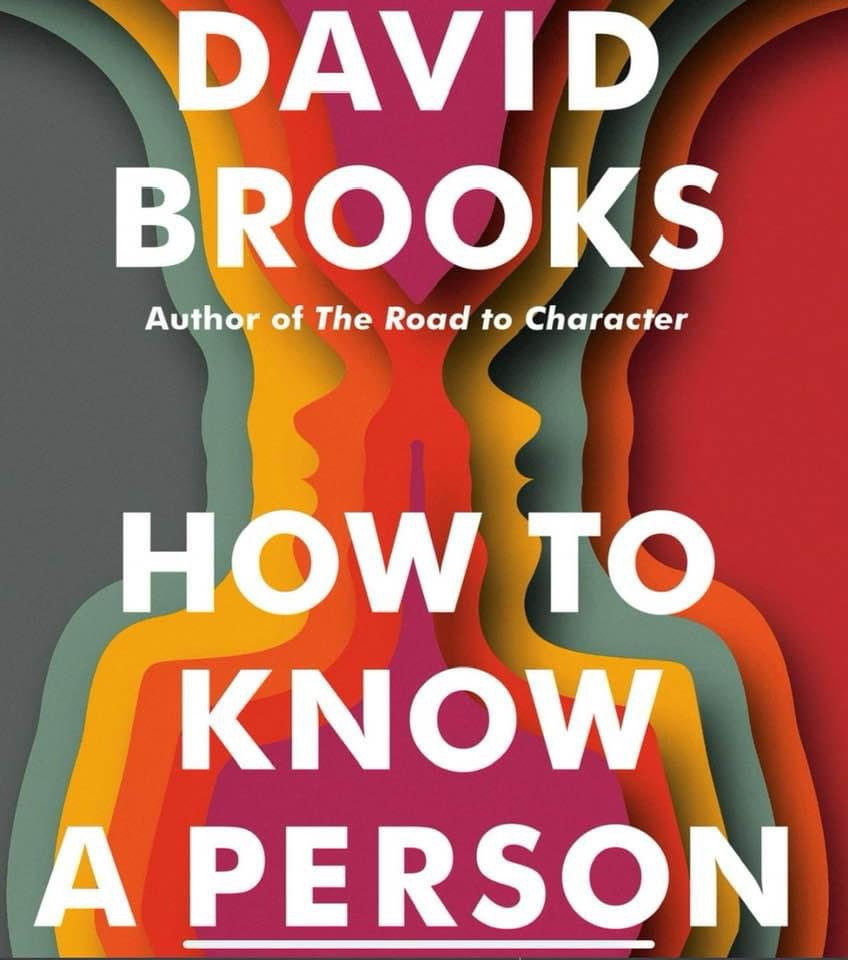
While reading “How to Know a Person,” by David Brooks, I had several “aha” moments. Early in the book, he points out that what a person really wants is to be seen, to be heard. “Human beings need recognition as much as they need food and water. No crueler punishment can be devised than to not see someone, to render them unimportant or invisible… On the other hand, there are few things that are as fulfilling as that sense of being seen and understood.”
The author goes on to quote George Bernard Shaw: “but to be indifferent to them: that’s the essence of inhumanity.” In our current society, it’s so easy to brush people off, to avoid any semblance of deep conversation and to stay in the safe, shallow mode of conversation.
But it’s there that loneliness thrives. People are meant to be social, to interact with others on the regular. Why it so hard to really get to know a person – and why don’t we try harder to make that happen? And what is it about some people that make us feel “seen” or want to open up and get to know them better? Finally, how can we be more like those people?
As the poet Maya Angelou is famously quoted: “I’ve learned that people will forget what you said, people will forget what you did, but people will never forget how you made them feel.” I think most of us can think of people we just don’t feel comfortable around. Maybe we can’t put a finger on why that is, what they did or said, but there’s a feeling in our gut that tells us they won’t have our back.
What are the qualities of people we do want to be around? People that lift us up, inspire us, leave us feeling that we’ve been heard, that we are seen? That we matter? Sometimes it’s just taking the time to learn how to be a good conversationalist. To ask the right questions and to listen.
In his book, David Brooks defines what does and doesn’t define a good conversationalist. “Being a mediocre conversationalist is easy. Being a good conversationalist is hard… A lot of people think a good conversationalist is someone who can tell funny stories. That’s a raconteur.
A lot of people think a good conversationalist is someone who can offer piercing insights on a range of topics. That’s a lecturer… A good conversationalist is a master of fostering a two-way exchange. A good conversationalist is capable of leading people on a mutual expedition toward understanding.”
People who are good communicators tend to possess the traits that people most admire in others. After asking friends and readers: “what qualities do you most admire in others,” I wasn’t surprised that the top included: honesty, kindness, authenticity, integrity, punctuality, compassion, manners and the willingness to listen.
I was surprised by what traits were not mentioned. No one mentioned success, fame or wealth. What does that tell us about our society’s focus on these characteristics? How can it be that the most ubiquitous post topics on social media aren’t the popularity magnets we think they are?
In “Never Enough, From Barista to Billionaire,” author Andrew Wilkinson writes about hitting it big: “First you equip your house with top electronics. Then you buy a fast car. Then a vacation house. Any maybe another.” But before long, he discovered, each new purchase gets old… “Nor do expensive toys buy the admiration of others.
Or, as his friend and investor Morgan Housel stated: “People aren’t thinking ‘Wow, I’m impressed by this person!’ They’re thinking: ‘I wish I had that house.’ And about you, they’re most likely thinking in the uncomplimentary terms that arise from envy.”
Maybe we all need to be reminded about what really connects us with others – to think about the qualities we value in people, and to have those good conversations. As David Brooks writes in his book, “we all know people who are smart. But that doesn’t mean they are wise. Understanding and wisdom come from surviving the pitfalls of life, thriving in life, having wide and deep contact with other people.” Wise words, indeed.
 Midlife Musings