
This column was written for Braver Angels of East Central Illinois as part of their series in the News-Gazette. For more information about this non-partisan organization, visit http://www.braverangels.org
We often talk of free speech when defending the right to say whatever we want. We can utter just about anything without fear of punishment. Still, it’s hard to understand why people intentionally choose words that inflame and offend instead of using more neutral terms.
It happens all too often. You’ll be watching the news or reading an article – and there it is… that word or phrase that makes you cringe. Or when scrolling through the comment section of an article covering a controversial topic, the discussion quickly turns adversarial. Angry readers make personal attacks and others pile on – it all goes downhill from there.
A wise friend once told me, “When the name calling starts, the argument has been lost.”That’s because there is no interest in listening to learn. The practice of using slurs or insults is an attempt to discredit, or shut-down those with opposing views. But, at what cost? Does winning an argument by shaming the other person do anything to solve the problems we are facing?
Multiple surveys show that most people, regardless of where they fall on the political spectrum, are tired of the hateful words and rhetoric. They want to get along and are willing to make the effort. But it takes work and it’s easy to fall back into old habits.
“Sometimes when people are in groups that are like-minded, they are very comfortable using very negative words about the other party, people of the other party, candidates and elected officials of the other party,” says Carol Bosley, a member of our local alliance of Braver Angels.
“To me it feels a bit like people feeling comfortable telling racist jokes when they are with their own people – using racist terms when they are comfortable in that group and don’t feel they will be called out on it – or men telling sexist jokes about women and using sexist words or descriptions of women when with men.”
“Even though they feel they are not offending anyone, because that person/group is not in the room, it perpetuates the comfort of name-calling and normalizing language that is detrimental and negative and divisive. I think like-minded people need to call out their like-minded friends when this occurs.”
Often the barbs are intentional, but sometimes they are just poor word choices. Peoplemay use a word thinking they know what they mean, and that the other person does too – not realizing their different assumptions can quickly muddy the conversation. You can waste a lot of time just trying to figure out what the other person is really talking about.
It’s also become commonplace to make broad generalizations based solely on party affiliation. Lori DeYoung describes how she felt when asked; “How can you be a Christian and be a Democrat?” She says, “Of all the divisive things I have encountered, that has to be the most hurtful.”
Kathy Young, an active volunteer for decades, is frustrated when people make comments like; “Republicans are selfish.” She suggests, “If they are genuinely curious, they could start a conversation about altruism or the underlying causes of poverty.”
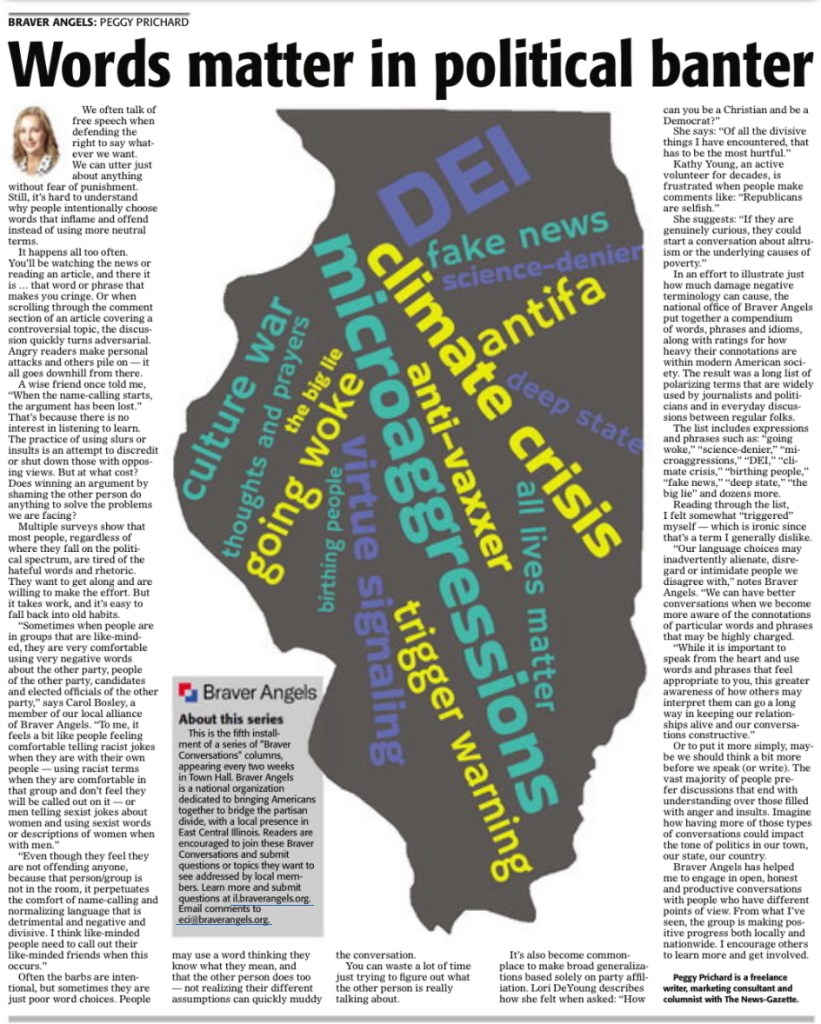
In an effort to illustrate just how much damage negative terminology can cause, the national office of Braver Angels put together a compendium of words, phrases, and idioms, along with ratings for how heavy their connotations are within modern American society. The result was a long list of polarizing terms that are widely used by journalists, politicians and in every-day discussions between regular folks.
The list includes expressions and phrases such as: going woke, science-denier, micro-aggressions, DEI, climate crisis, birthing people, fake news, deep state, the big lie and dozens more. Reading through the list, I felt somewhat “triggered” myself – which is ironic since that’s a term I generally dislike.
“Our language choices may inadvertently alienate, disregard, or intimidate people we disagree with,” notes Braver Angels. “We can have better conversations when we become more aware of the connotations of particular words and phrases that may be highly charged. While it is important to speak from the heart and use words and phrases that feel appropriate to you, this greater awareness of how others may interpret them can go a long way in keeping our relationships alive and our conversations constructive.”
Or to put it more simply, maybe we should think a bit more before we speak (or write). The vast majority of people prefer discussions that end with understanding over those filled with anger and insults. Imagine how having more of those types of conversations could impact the tone of politics in our town, our state, our country.
Braver Angels has helped me to engage in open, honest and productive conversationswith people who have different points of view. From what I’ve seen, the group is making positive progress both locally and nationwide. I encourage others to learn more and get involved.
 Midlife Musings